
From Farm to EU Market: PiLAF Brown Bag Series Explores the Role of Private Extension in Sustainable Certification
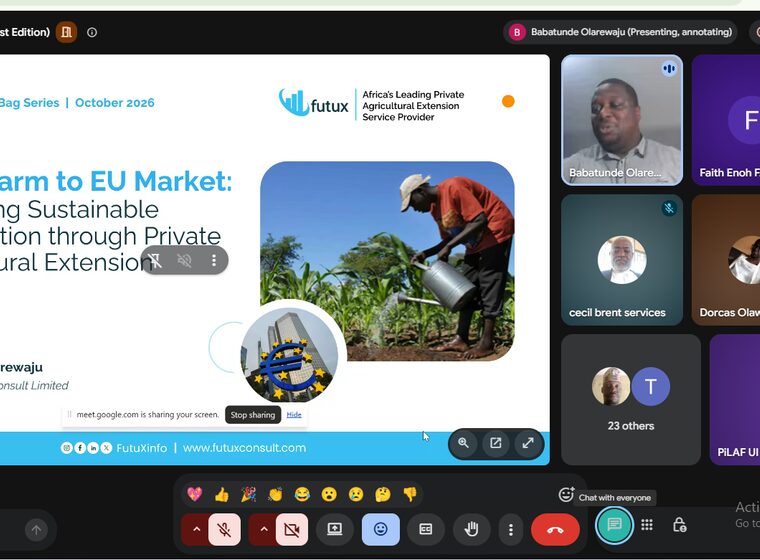
The Innovation Lab for Policy Leadership in Agriculture and Food Security (PiLAF), University of Ibadan, hosted the 21st edition of its Brown Bag Series on the theme “From Farm to EU Market: Unlocking Sustainable Certification through Private Extension.” The session featured Babatunde Olarewaju, Founder and Chief Executive Officer of FutuX Agri-consult Limited, who shared practical insights into how private agricultural extension can help farmers and agribusinesses meet sustainability standards and access international markets.
The discussion examined a critical challenge facing agricultural value chains in Africa: the difficulty of translating good farm-level production into consistent, compliant, traceable products that meet the requirements of international buyers.
Private Extension as a Link Between Farmers and Markets
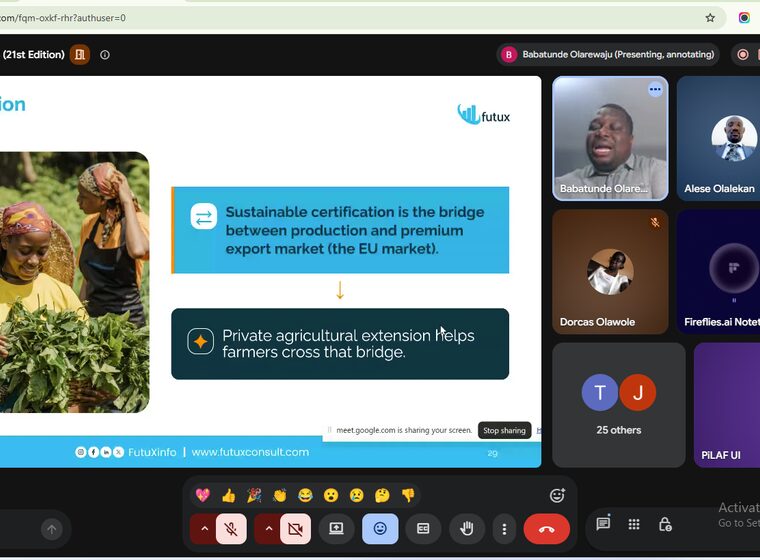
In his presentation, Olarewaju explained that private agricultural extension goes beyond improving crop yields and introducing innovative or climate-smart practices. It connects production advice directly to the requirements of local, regional, and international markets.
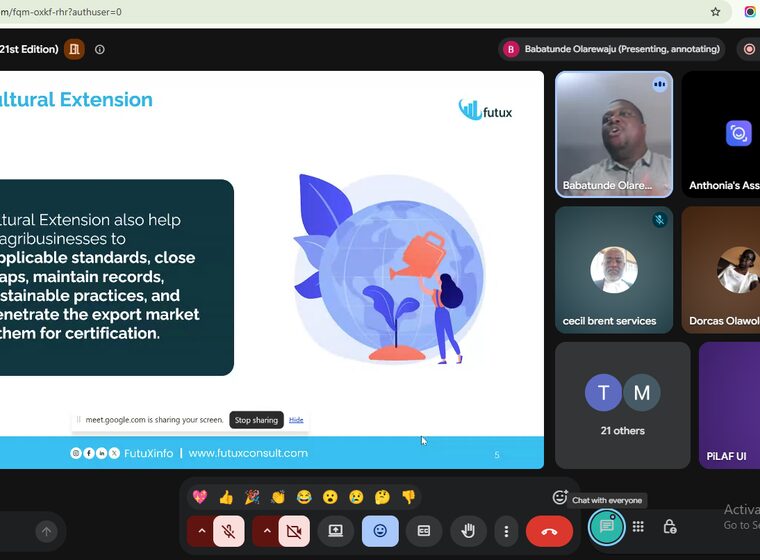
Private extension providers help farmers and agribusinesses understand applicable standards, translate complex requirements into practical farm-level activities, maintain production records, address compliance gaps, and adopt sustainable practices. This market-oriented approach helps align what farmers produce with what buyers demand.
Understanding Sustainable Certification and Export Requirements
The session distinguished between mandatory standards required by law and voluntary standards often demanded by buyers. Examples discussed included phytosanitary requirements and maximum residue limits for chemical residues, alongside certification schemes such as Rainforest Alliance, Fairtrade, GlobalG.A.P., Union for Ethical BioTrade, and organic certification.
Olarewaju highlighted the importance of understanding the specific requirements associated with each market and product. Accessing the EU market requires more than producing quality crops; it also demands attention to food safety, chemical compliance, traceability, responsible sourcing, labour practices, and reliable documentation.
Private extension can help bridge the gap between these requirements and the realities of smallholder farming by translating standards into practical, measurable actions.
Addressing the Challenges of Certification
The presentation identified four major reasons certification efforts may fail: weak record-keeping, poor traceability, inconsistent implementation of standards, and inadequate technical support.
To address these challenges, FutuX Agri-consult Limited adopts an implementation approach that begins with a gap assessment of existing farm practices. This informs a work plan covering farmer training, field monitoring, record management, internal audits, and preparation for external certification audits.
The approach also incorporates an extension model that supports regular engagement with farmers and systematic collection of production information. During the discussion, Olarewaju explained how digital tools, including FutuX’s Farm Droit application, support record-keeping, farm mapping, production monitoring, and traceability.
Practical Lessons from FutuX Agri-consult Limited
Drawing on its experience supporting farmers and agribusinesses, FutuX shared a case study of a company that experienced significant export difficulties when attempting to enter the EU market because of compliance gaps, limited market readiness, and inadequate direct farmer traceability.
Following FutuX’s intervention—which included compliance assessments, gap analysis, food-safety risk reviews, documentation, training, and internal audits—the company achieved certification and sustained compliance through subsequent surveillance audits. The case illustrated the importance of preparing farmers and exporters for market requirements before attempting to access demanding export destinations.
The presentation also highlighted the potential commercial value of certification, including access to premium buyers, stronger supplier relationships, improved traceability, and price premiums for certain certified products. Such benefits, however, depend on the applicable certification scheme, buyer arrangements, and the ability to meet required standards consistently.
Engaging Stakeholders on Scaling and Quality Assurance
The question-and-answer session broadened the discussion to include digital extension, quality assurance, farmer clustering, support for middlemen and exporters, post-harvest losses, farmer resistance to new practices, and opportunities for expanding into additional export crops.
Participants explored how extension providers can support dispersed smallholder farmers, encourage consistent agricultural input use, maintain quality standards, and build systems that make certification more practical at scale.
The exchanges reinforced the importance of sustained farmer engagement, appropriate incentives, reliable monitoring, and collaboration among farmers, exporters, extension providers, and other value-chain actors.
Strengthening Sustainable Agricultural Market Access
The 21st PiLAF Brown Bag Series underscored the role of private extension in connecting agricultural production with the standards and expectations of international markets. By combining technical guidance, farmer training, digital record-keeping, traceability, and compliance support, private extension can contribute to more reliable agricultural supply chains and improved market readiness.
The session also highlighted the need for coordinated efforts to ensure that certification is not merely a formal requirement, but part of a practical system that supports responsible production, quality assurance, and sustainable commercial relationships.
Through its Brown Bag Series, PiLAF continues to provide a platform for knowledge exchange on agricultural and food-system issues, bringing together practical experience and policy-relevant discussions to support more informed decision-making.
Watch the full session: https://youtu.be/-D-mIzZdA4o